
Rethinking MAD
The new history of US-Soviet military competition

The US-Soviet arms race was the largest in world history. Washington and Moscow fielded vast ground, naval and air forces, and enough nuclear weapons to sterilize much of the planet.
However, the nature of that competition—not the old question of the Cold War’s origins, but the purpose of specific military policies—has long been obscure, especially at the nuclear level.
Many accounts frame the nuclear arms race as quixotic, given the reality of “mutual assured destruction” (MAD), and actually designed to satisfy narrow interest groups beneath the formal decision-making layer. They portray the arms control agreements in the 1970s, by contrast, as triumphs of cooperation that cooled tensions, saved resources and avoided the emergence of first-strike incentives. Finally, many accounts cast the absence of such incentives as “canceling out” each side’s nuclear threats and restoring the primacy of the conventional balance in Europe.
In fact, MAD was never a stable and fixed condition, but a delicate balance of forces that both sides thought could be overcome, second-guessed and wielded for geopolitical advantage.
Relentless competition
Many scholars portray MAD as simple to achieve and virtually impossible to escape. Nuclear warheads are relatively cheap, major cities few in number. Nuclear launch platforms, though vulnerable once located, are easy to hide. And anti-ballistic missile (ABM) defenses, while effective against small attacks, can be quickly overwhelmed. Consequently, pouring money into warheads, launch platforms and ABM systems after MAD has been reached is as useful as burning it. An adversary might disagree and keep arming, but the state can ignore all but the widest shifts in relative force size since even a small fraction of its arsenal is enough to destroy the adversary’s society.
In practice, of course, America and the Soviet Union relentlessly built nuclear weapons. The standard explanation on the US side has been the outsized influence of domestic interest groups. In this view, political leaders caved to congressional tie breakers beholden to military-industrial donors or eager for procurement contracts in their home districts, and to military officials seeking increased funding to ease departmental conflicts or underwrite arcane warfighting strategies that preserved their organizational autonomy. Another explanation blames psychological bias for the continued association of national interest with quantitative military advantage long after it had objectively broken down.1
Recent historical and technical analyses, however, shed light on the realist foundations of Cold War nuclear competition. MAD persisted, but the strategic balance was technologically fragile.2 Escape was difficult, but far from impossible. Key parts of the balance were opaque to even the best informed civilian analysts, but plainly visible to policymakers.
It is now clear, for example, that seafloor sensors enabled US anti-submarine warfare (ASW) forces to trail most Soviet ballistic missile submarines (SSBNs) as they ventured through bottlenecks into the Atlantic and Pacific or came within firing range of the American coastline. According to one well-placed former US official, until the early 1970s American ASW forces “could have taken out the entire deployed [Soviet SSBN] fleet on a signal,” while the fleet left in port would have been entirely exposed to nuclear attack.3
In the 1970s and 1980s, increasingly accurate American submarine-launched and intercontinental ballistic missiles (SLBMs and ICBMs) also began to jeopardize the Soviets’ huge land-based arsenal.4 Fortunately for Moscow, efforts to drastically increase the range of its SLBMs had borne fruit, allowing Soviet submarines to lurk in heavily defended “bastions” in the Barents and Okhotsk seas.
Ultimately, the Soviet Union retained an assured-destruction force because its windows of vulnerability on land and at sea did not overlap. Yet undersea competition continued, and the survivability of Soviet SSBNs remained sensitive to uncertain trends in sensor technologies, which in the late Cold War were allowing US ASW forces to begin to track them inside the bastions.

The US second-strike, meanwhile, stayed robust; in the event, much of the American buildup was unnecessary for preserving MAD. Nonetheless, it served as a hedge against technological shocks. As one Defense Department expert told Henry Kissinger in 1971, the US government could not “with real confidence predict that no serious threat to [our] submarines”—the most survivable leg of the triad—”will develop in the latter part of the 1970’s.” Were one to, “[w]e would have a limited period of time in which to develop counter-measures.”5 And officials had other reasons, as discussed below, to favor arming.
Competitive arms control
If a fragile strategic balance coaxed American and Soviet policymakers into relentless nuclear competition, why did they pursue arms control negotiations in the 1970s? The Strategic Arms Limitation Talks (SALT) agreements—which comprised the ABM Treaty and the Interim Agreement on Offensive Forces—stands out in most traditional accounts as a rare case of mutual interest overcoming myopic belligerence to curb an otherwise unstoppable arms race.
In this view, negotiations rested on a shared understanding of strategic stability theory. Developed in the 1950s and early 1960s, it highlights the risk of incentives for preemption. An ability to limit damage by striking the other side’s nuclear forces preemptively, theorists argued, could lead one side’s expectations of war—or belief that the adversary expects war, or that the adversary thinks it believes the adversary expects war, and so on—to disastrously self-fulfill.
Many analysts went further, arguing that competition was futile as well as dangerous, given the difficulties of counterforce. Washington and Moscow should thus come to terms with MAD and renounce efforts to protect themselves.
Many on the left welcomed SALT, while conservative critics lambasted officials like Henry Kissinger for prematurely tapping out of the nuclear struggle, but both sides’ understanding of the negotiations was essentially alike. In Robert Jervis’s words, for proponents and detractors alike SALT “represented the triumph of academic ideas and a new understanding of how wars start and, correspondingly, how they could be avoided.”6 Its ultimate failure to halt the arms race was then widely attributed to Soviet intransigence.7 Before entering office, for example, Ronald Reagan opined that with SALT, “the Soviets began their exploitation of our naïve[ty].”8
This popular image of arms control, however, was mostly a fiction. In private, top US officials saw SALT not as an alternative to the arms race but as a ploy to divert it onto more technologically advantageous terrain. While President Richard Nixon portrayed the 1972 agreements to the public and to doves in Congress as cornerstones of his effort to stabilize deterrence, a sweeping cooperative agreement had never been on the table. In Brendan Green’s words, “The paucity of genuinely stabilizing arms control agreements… [was] not a missed opportunity, but the product of conscious design.”9
The story is complex; SALT negotiations combined conceptual subtlety with high stakes. The devil—how an agreement affected each side’s core security—lurked in details like how to classify an “ABM-capable radar” and what counted as a “heavy ICBM.” Divisions among officials were often fierce, pitting dovish State Department and arms control agency representatives against Pentagon and Joint Chiefs of Staff hawks.
Nixon and Kissinger were in charge, however, and mostly sided with the hawks. The basic logic of US arms control strategy was that despite MAD, strategic advantage could still be gained by exploiting economic and political asymmetries in competitive fitness, particularly in the extraction and efficient mobilization of resources. The Soviet economy produced less wealth, but the absence of popular and institutional constraints on extracting wealth for military purposes gave Moscow the upper hand in quantitative arms racing. Conversely, America’s technologically sophisticated defense industrial base and comparatively rational civil-military decision process enabled resources to be more efficiently converted into military capabilities, priming Washington for qualitative competition.10
Accordingly, US officials aimed to establish a ceiling on ballistic missile numbers that could displace competitive activity from the extensive to the intensive margin, where America’s technological and bureaucratic advantages could be brought to bear.
Rather than building ever more missiles, the US could add warheads through multiple independently targetable reentry vehicles (MIRV), and improve their accuracy, to hold Soviet land-based nuclear forces at risk. A missile ceiling could also facilitate competition in strategic cruise missiles, modernized strategic bombers, and in particular accurate SLBMs, which were heretofore ineffective against hardened silos and useful only as “city-busters.” The resulting agreements banned ABM deployments and enshrined the Soviet Union’s quantitative superiority in launchers, but set the stage for American qualitative dominance.
Soviet motives in SALT remain somewhat opaque, and indeed, competitive agreements themselves pose a puzzle because shifts in the strategic nuclear balance are zero-sum. The simplest analysis mirrors a no-trade theorem: every offer a rival makes will be i) crafted to undermine the state’s competitiveness and ii) informed by the rival’s private information about its own competitive strengths, and should thus be rejected. If both parties seek strategic advantage but can nevertheless reach an agreement, they must disagree on their relative strengths, or on the likely path of innovation in particular weapon systems, or on the relative value of definite near-term versus uncertain future advantages.11
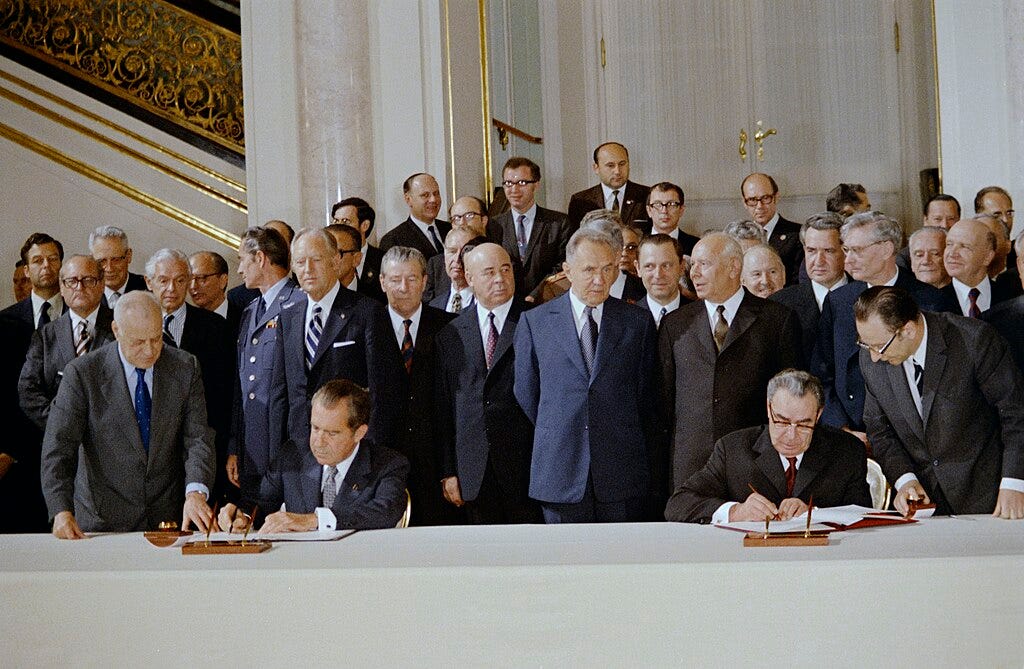
Each likely played some role in SALT. For Soviet leader Leonid Brezhnev, such high-level negotiations were also a way of achieving a kind of equal status alongside Washington, and he appears to have genuinely wanted improved superpower relations to reduce the risk of nuclear war. Yet he was also satisfied that the agreements would disproportionately benefit Moscow, and privately assured Kremlin colleagues that SALT “would in any case not obstruct in any way the implementation of the previously envisioned measures to strengthen our country’s defense.”12
In terms of offensive forces, the Soviets seemed prepared to risk their long-term competitiveness for an agreement that formalized their existing quantitative advantages.13 The Soviets also aimed to avoid an ABM competition, though not because they were reconciled to MAD. “When the Politburo did act to limit major weapons systems,” John Maurer notes, “…it did so only after Soviet military-technical authorities had concluded that the weapon could not be made to work.”14 American hawks likewise refused to consider an ABM ban until they were confident that effective defense of cities from a massed ICBM attack remained technologically infeasible.15
The allure of instability
Soviet and US officials both understood the dangers of first-strike incentives in the late Cold War, but the logic of cooperation was not clear cut. Were competitive policies are doomed to fail in military terms, cooperation would be pointless. Competition should fizzle out after each side acquires large second-strike forces, and “excess” arming by the other could be safely ignored.16
Yet in a world where competitive policies might facilitate an escape from MAD, a trade-off re-emerges. A more delicate nuclear balance makes an adversary’s efforts more dangerous, but a state’s own efforts also become more promising.17 Escape could take three forms: the state escapes, its adversary escapes, or both do. The first case is clearly desirable, the second clearly undesirable. While strategic stability theory emphasizes the dangers of the third, the overall impact is not clear cut. While crises would be more likely to erupt into nuclear war, the net change in risk would be ambiguous, since states which recognize the heightened danger would be more reluctant to precipitate crises.
Competitive policies can also provide benefits short of escaping stalemate. By forcing an adversary to make countervailing investments to sure up their deterrent, a broad buildup could strain its resources and thus generate domestic pressure to resolve key disputes. A narrower buildup could do the same while also forcing the adversary to shift resources away from more to less advantageous areas of the balance, such as from land-based forces to submarines.18
Uncertainty about strategic beliefs can also incentivize arming. If an adversary seems to doubt stalemate—an inherently subjective condition—or to assume that escalation across different theaters or target categories is only weakly interlinked, the state might feel pressured into a buildup to dispel the adversary’s unwarranted confidence.19 Such uncertainties often plagued US officials. As Green notes, Moscow’s diplomatic approach “seemed to suggest that the Soviets feared even the marginal nuclear weapon that could hit their territory... [and] explicitly rejected Western notions of stability… [while] Soviet military doctrine and exercises stressed notions of a “theater nuclear balance” somehow distinct from the central balance.20 On the flip side, competitive policies could make an adversary more uncertain about its own perceived ability to retaliate and leave it warier about selecting into crises.
The difficulty of reliably enforcing agreements also made genuine cooperation less attractive. Part of the problem was inherent: enforcement means verification, and easier verification makes forces less survivable, all else equal. In Marc Trachtenberg’s words, maximum verifiability means weapons must be “countable, identifiable, and therefore targetable and destroyable.”21 And part of it depended on the political structure of each state. In the US, for example, powerful dovish factions might plausibly have restrained the White House from withdrawing in response to violations by Moscow, while opaque Soviet military organizations were reluctant to allow US inspectors to verify their compliance.
Overall, relentless nuclear competition does not seem to have stemmed from American officials giving in to pressure from domestic interest groups. On the contrary, Congress often pushed back on the political leadership’s remorselessly competitive instincts and the military preferred to lobby for the larger sums required for conventional forces. Instead, top officials saw nuclear competition as unavoidable.22
MAD and the European Cold War
In much popular commentary, MAD amounts to strategic paralysis. Either nuclear powers cannot go to war, because total war would destroy both sides, or wars among nuclear powers will reliably remain conventional, given that nuclear escalation cannot yield a military advantage.
The latter dovetails a common thread in classic Cold War historiography, which held that the Soviet Union’s acquisition of a large nuclear second-strike capability in the 1960s led to a fundamental shift in US conventional deterrence policy.
Because it could no longer able to withstand or effectively preempt Moscow’s retaliation, many scholars have argued, Washington’s shift from a “massive retaliation” strategy to “flexible response” greatly reduced its reliance on nuclear weapons to deter a Soviet invasion of Western Europe. In Hal Brands’ words, “MAD was lethal to a military strategy that required nuclear escalation to compensate for America’s inability to defend far-flung allies conventionally.”23
The rapid growth of the Soviet nuclear arsenal did indeed prompt Western powers to maintain stronger conventional forces after the 1950s, sufficient to meet a wider variety of possible military contingencies without resorting to nuclear use. Policymakers and analysts, meanwhile, frequently debated the wisdom of any level of reliance on nuclear weapons.
More recent historical accounts, however, emphasize the continuities in US military policy in Europe.24 Long after the onset of MAD, the specter of nuclear annihilation still dominated both sides’ calculations.
NATO forces arrayed along the central front were thought capable of defeating small- and medium-scale Warsaw Pact attacks. Nonetheless, deterrence of full-scale attacks largely hinged on employing limited nuclear options (LNOs) to deliberately generate a risk of escalation to all-out counter-city attacks that exceeded Moscow’s tolerance.25 As one top secret Pentagon report explained, the approach assumed “that statesmen define some limits as to the losses (costs) they are willing to suffer to achieve their objectives,” and sought “to coerce the enemy into negotiation for early war termination by striking relatively small numbers of selected targets [with nuclear weapons] and providing a deterrent to further escalation by holding forth the prospect of subsequent massive attacks on targets he values highly.”26
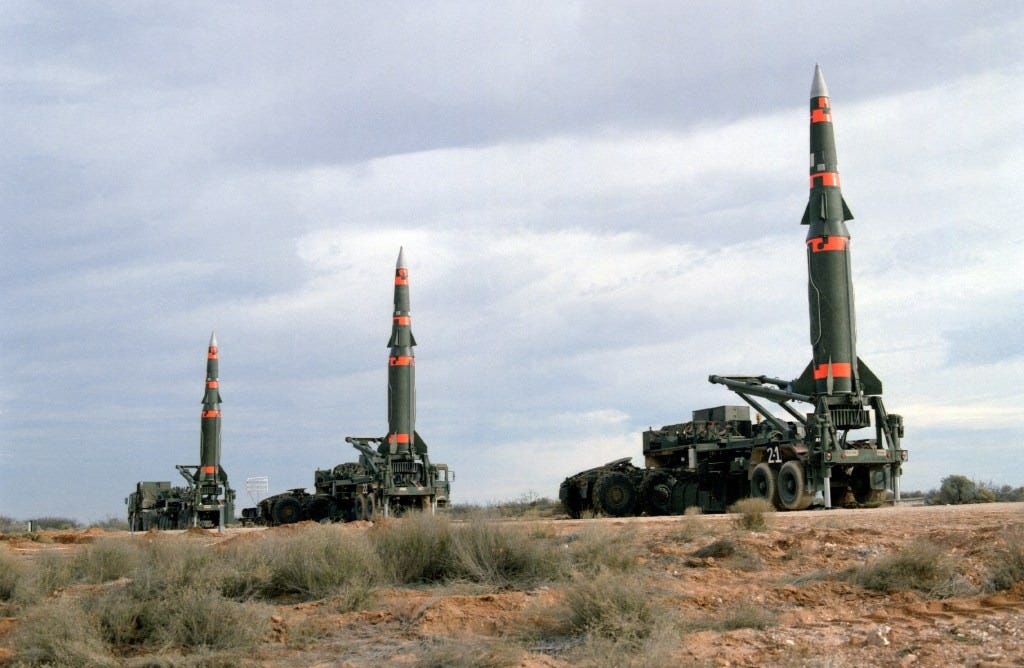
The basis of LNOs was the tactical nuclear weapon. Despite their name, in a MAD environment these weapons are not supposed to alter battlefield outcomes. Early theorists did emphasize their potential to neutralize massed Soviet armor and deter its concentration in densities sufficient to break through Western defenses. But Soviet tactical capabilities were soon mirroring those of the US. Once optimal battlefield employment would rapidly destroy both sides’ conventional forces, the military utility of tactical weapons was lost.27
Plans for “tactical” use were not abandoned, however, and the inherent vagueness of the tactical/strategic distinction became a feature rather than a bug. The threat of tactical use instead served to “couple” a conventional clash to the strategic level by giving Washington the ability to actively risk, but not guarantee, catastrophic escalation. Tactical weapons could transform a major conventional war into what Thomas Schelling termed a “competition in risk-taking,” wherein the rising probability of strategic nuclear war dominates both sides’ calculations and the outcome is determined by the balance of resolve, or state’s relative preparedness to escalate. Thus, official thinking went, LNOs could close much of the credibility gulf opened by MAD.28
Disagreements over the specifics of tactical use were never completely ironed out, but their presence does seem to have made the right impression. In the words of one well-placed Soviet military analyst, they served as “a means of containment, since nobody wanted to start the war under these circumstances.” Although the Soviet military leadership believed it could overwhelm NATO’s conventional forces in a matter of weeks, the large-scale deployment of tactical nuclear weapons “fundamentally changed the situation, and made it impossible to carry out any operation in the western direction... our military leadership of that time had a good understanding of this issue.”29
Although the end of the Cold War reshaped geopolitics, some of the competition’s basic contours—the relentless drive for unilateral damage-limitation, a zero-sum approach to negotiations, and the primacy of nuclear weapons—emerged unaltered.
Initially, the US forged ahead. A key technological development was the increased vulnerability of ICBM silos. During much of the Cold War, missiles would have been too inaccurate to destroy hardened silos with high probability, necessitating follow-on strikes. Yet such strikes would have a narrow window to avoid “fratricide”: any warhead arriving less than three-to-five seconds after the first would be destroyed by the initial blast, while oncoming warheads arriving more than six-to-eight seconds later would be torn apart in the ensuing dust cloud. Late 20th century advances in precision and computing, however, enabled warheads to either explode within range or fail without detonating close enough to shroud the target.30
While US capabilities advanced, Russian systems decayed, and by the mid-2000s, that combination allowed Washington to effectively escape MAD. For a number of years, the US could plausibly have neutralized Moscow and Beijing’s entire long-range nuclear arsenals in a surprise “bolt-from-the-blue” attack.31
American nuclear primacy proved fleeting, as Russia and China increasingly switched to survivable basing modes. Such primacy may never emerge again. But states cannot (and will not) take nuclear stalemate for granted, as the Cold War experience demonstrates.
See e.g. McGeorge Bundy, “To Cap the Volcano,” Foreign Affairs, Vol. 48, No. 1 (Oct. 1969); and Charles L. Glaser, Analyzing Strategic Nuclear Policy (Princeton, NJ: Princeton University Press, 1989), pp. 365-367.
See especially Brendan Rittenhouse Green and Austin Long, “Stalking the Secure Second Strike: Intelligence, Counterforce, and Nuclear Strategy,” Journal of Strategic Studies, Vol. 38, Nos. 1-2 (2015), pp. 38-73; Brendan Rittenhouse Green and Austin Long, “The MAD Who Wasn’t There: Soviet Reactions to the Late Cold War Nuclear Balance,” Security Studies, Vol. 26, No. 4 (2017), pp. 606-641; Brendan Rittenhouse Green, The Revolution That Failed: Nuclear Competition, Arms Control, and the Cold War (New York: Cambridge University Press, 2020); Keir A. Lieber and Daryl G. Press, The Myth of the Nuclear Revolution: Power Politics in the Atomic Age (Ithaca, N.Y.: Cornell University Press, 2020), chap. 3; and Timothy D. McDonnell, “The Terrible Swift Sword: US Nuclear Posture and Foreign Policy,” PhD diss. (Massachusetts Institute of Technology, 2019).
Quoted in Green, The Revolution That Failed, p. 36
Long and Green, “The MAD Who Wasn’t There.”
“Defense Program Review Committee Meeting,” March 17, 1971, Foreign Relations of the United States (FRUS), 1969-1976 (Washington, D.C.: Government Printing Office), Vol. 34, pp. 756-757.
Robert Jervis, “The Many Faces of SALT,” Journal of Cold War Studies, Vol. 24, No. 4 (Fall 2022), p. 199.
Marc Trachtenberg, “The United States and Strategic Arms Limitation During the Nixon-Kissinger Period: Building a Stable International System?” Journal of Cold War Studies, Vol. 24, No. 4 (2022), esp. pp. 192-197; Niall Ferguson, “Kissinger and the True Meaning of Détente,” Foreign Affairs, February 20, 2024.
Quoted in William Inboden, The Peacemaker: Ronald Reagan, the Cold War, and the World on the Brink (New York: Penguin, 2022), p. 33.
Green, The Revolution that Failed, p. 64.
John D. Maurer, Competitive Arms Control: Nixon, Kissinger, and SALT, 1969-1972 (New Haven, Conn.: Yale University Press, 2022); Green, The Revolution that Failed, pp. 55-65. Domestic pressure against military spending from the fallout over Vietnam also lowered Washington’s aptitude for quantitative competition.
Green, The Revolution That Failed, pp. 58-59; Maurer, Competitive Arms Control, pp. 187-188.
Quoted in Sergey Radchenko, To Run the World: The Kremlin’s Cold War Bid for Global Power (New York, NY: Cambridge University Press, 2024), p. 380.
Maurer, Competitive Arms Control, pp. 187-188.
Maurer, Competitive Arms Control, p. 100.
Maurer, Competitive Arms Control, p. 80.
Jervis, “The Many Faces of SALT,” p. 202; Trachtenberg, “The United States and Strategic Arms Limitation During the Nixon-Kissinger Period,” p. 167.
Trachtenberg, “The United States and Strategic Arms Limitation During the Nixon-Kissinger Period,” p. 169.
Green, The Revolution That Failed, pp. 49-52.
Green, The Revolution That Failed, pp. 44-46.
Green, The Revolution That Failed, p. 44.
Trachtenberg, “The United States and Strategic Arms Limitation During the Nixon-Kissinger Period,” p. 166.
Green, The Revolution That Failed, p. 250; McDonnell, “The Terrible Swift Sword,” pp. 54-59.
Hal Brands, The Twilight Struggle: What the Cold War Teaches Us About Great-Power Rivalry Today (New Haven, Conn.: Yale University Press, 2022), p. 61.
See e.g. Francis J. Gavin, Nuclear Statecraft: History and Strategy in America’s Atomic Age (Ithaca, NY: Cornell University Press, 2012), chap. 2; Lieber and Press, The Myth of the Nuclear Revolution, pp. 64-65; and Alex Hughes, “Wielding Armageddon: Nuclear Weapons and Conventional Deterrence in U.S. Cold War Grand Strategy” (unpublished manuscript, 2025).
I use “LNO” to refer to the limited use of nuclear weapons for bargaining purposes rather than the specific operational definition used by U.S. planners in the late Cold War. On the latter, see e.g. Terry Terriff, The Nixon Administration and the Making of U.S. Nuclear Strategy (Ithaca, NY: Cornell University Press, 1995), chap. 7.
“Current U.S. Nuclear Employment Policy,” August 12, 1977, FRUS, 1977-1980, Vol. 4, p. 165.
A conceptually clearer distinction, as Glenn Snyder notes, would separate strategic and tactical nuclear operations rather than weapons. Glenn H. Snyder, Deterrence and Defense: Toward a Theory of National Security (Princeton, NJ: Princeton University Press, 1961), p. 137 n. 15. On the evolution of theorizing about tactical nuclear use, see e.g. Andrew L. Ross, “The Origins of Limited Nuclear War Theory,” in Jeffrey A. Larsen and Kerry M. Kartchner, Limited Nuclear War in the 21st Century (Stanford, Calif.: Stanford University Press, 2014).
Thomas C. Schelling, Arms and Influence (New Haven: Yale University Press, 1966), chap. 3; Robert Jervis, “The Nuclear Age: During and After the Cold War,” in Fritz Bartel and Nuno P. Monteiro, Before and After the Fall: World Politics and the End of the Cold War (New York: Cambridge University Press, 2021), pp. 123-124.
Quoted in Jan Hoffenaar and Christopher Findlay, eds., Military Planning for European Theater Conflict During the Cold War: An Oral History Roundtable, Stockholm, 24-25 April 2006 (Zurich: Center for Security Studies, 2006), pp. 65-66.
Keir A. Lieber and Daryl G. Press, “The End of MAD? The Nuclear Dimension of U.S. Primacy,” International Security, Vol. 30, No. 4 (Spring 2006), pp. 7-44.
Keir A. Lieber and Daryl G. Press, “The New Era of Counterforce: Technological Change and the Future of Nuclear Deterrence,” International Security, Vol. 41, No.4 (Spring 2017), pp. 19-22.